In an era where sustainability has transitioned from a conceptual ideal to a fundamental business requirement, robust reporting on Environmental, Social, and Governance (ESG) factors, alongside broader sustainability initiatives, is indispensable. These reporting mechanisms are vital for organizations to foster openness, effectively manage potential risks, and attract the growing pool of responsible investment capital.
However, the landscape of ESG reporting is not uniform; frameworks differ significantly worldwide, shaped by local regulatory environments, market expectations, and national climate objectives.
This comprehensive guide explores prominent ESG and sustainability reporting frameworks across the globe, offering focused insights into the United Arab Emirates (UAE) and Germany – two influential economies actively shaping distinct sustainability agendas.
North America: Evolving Reporting Standards
North America is currently experiencing a notable evolution in its ESG reporting practices, progressively shifting from voluntary disclosures towards more structured and, in some cases, mandatory requirements.
United States: Several frameworks are in common use. One key standard offers industry-specific guidance for sustainability accounting. Another widely adopted initiative provides a framework for disclosing climaterelated financial information, with increasing regulatory emphasis. Recent developments include proposed rules for climate risk disclosure for public companies. Additionally, a major global platform is widely utilized for reporting environmental data. The overall trend indicates a move towards required disclosures, often aligning with emerging international standards.
Canada: Here, leading global reporting frameworks for sustainability, climate, and industry-specific disclosures are commonly employed. National securities regulators are also proposing climate-related financial disclosures that mirror international recommendations. Canada’s path mirrors that of the U.S., with voluntary reporting maturing into more structured and regulated systems.
Europe: Leading with Comprehensive Mandates
Europe stands at the forefront of global sustainability reporting, distinguished by its rigorous and mandatory frameworks, often incorporating a “double materiality” perspective (considering both financial and impact materiality).
European Union: A significant directive mandates extensive ESG disclosures for a large number of companies, with implementation beginning recently. This directive is supported by detailed European sustainability reporting standards that provide specific ESG metrics. The EU also employs a regulation that classifies and requires reporting on environmentally sustainable economic activities. Furthermore, a specific regulation targets ESG transparency within the financial sector.
Germany: As a key member of the EU, Germany adheres to the mandatory ESG disclosure requirements set forth by European regulations. Beyond these, a widely used voluntary German sustainability code is popular, particularly among small and medium-sized enterprises. A notable national law, enacted recently, requires companies to conduct due diligence for human rights and environmental risks within their supply chains. Germany’s focus on human rights, supply chain transparency, and robust ESG data governance sets a strong precedent.
Asia: Accelerating Towards Structured Reporting
Asia’s diverse economies are rapidly advancing their ESG reporting practices, demonstrating a clear trajectory towards regulated and assured frameworks.
India: A mandatory national business responsibility and sustainability report is required for top listed companies. More recently, a component of this report was introduced for mandatory assurance of ESG metrics. Globalized firms also utilize internationally recognized sustainability and industry-specific standards to align with the expectations of global investors.
China: Progress is underway on ESG rules inspired by climate-related financial disclosure frameworks for listed firms and state-owned enterprises. Major stock exchanges promote voluntary ESG disclosures through guidelines, with a strong national emphasis on green finance and emissions reporting.
Japan: Disclosures aligned with climate-related financial frameworks are mandatory for companies listed on the Prime Market. A major stock exchange group actively encourages ESG through sustainability indices and disclosure guidance, positioning Japan as a leader in climate-related financial disclosures in Asia.
United Arab Emirates: A Growing Hub for Sustainable Finance
The UAE is actively integrating sustainability into its national development agenda, evidenced by ambitious initiatives like national net-zero targets and its role as a recent host of a major global climate conference.
Key Frameworks: The financial market regulator provides ESG guidance for listed companies. Both major stock exchanges encourage ESG reporting based on widely recognized global frameworks such as those for general sustainability, industry-specific metrics, and climate-related financial disclosures. A national sustainable finance framework, introduced a few years ago, outlines policy directions for ESG integration in the finance sector. The UAE is seeing rapid growth in voluntary adoption and is actively aligning with emerging international sustainability standards, establishing itself as a regional leader in promoting sustainable finance.
Africa: Governance and Climate Resilience Driving Progress
Africa’s ESG landscape, while still largely voluntary in many areas, is gaining significant momentum driven by enhanced governance principles and concerns over climate resilience.
South Africa: A prominent code of governance emphasizes integrated thinking and ESG principles. The main stock exchange’s disclosure guidance aligns with leading global sustainability, climate, and emerging international standards, positioning South Africa with some of Africa’s most advanced ESG frameworks.
Rest of Africa: ESG reporting is predominantly voluntary, though initiatives from regional development banks and economic commissions are actively promoting green finance and climate disclosures. The relevance of ESG is increasing due to growing climate risks and evolving investor expectations across the continent.
South America: Addressing Environmental Imperatives
ESG adoption is on the rise in South America, spurred by pressing environmental challenges such as deforestation and water security.
Brazil: The national securities commission encourages ESG disclosures, with major global sustainability and environmental reporting frameworks being predominant among listed companies. The primary stock exchange supports ESG indices and best practices.
Chile, Colombia, Peru: Governments in these nations are increasingly promoting climate-aligned reporting, with international climate and emerging sustainability standards gaining recognition.
Oceania: Rapid Regulatory Development for Climate Action
Oceania is characterized by swift regulatory growth in ESG, primarily driven by strong commitments to climate action and the necessity for international market access.
Australia: Corporate governance principles recommend ESG disclosures where material risks are identified. Notably, mandatory climate reporting, set to begin soon, will align with international climate and emerging sustainability standards.
New Zealand: This country was the first to legislate climate disclosures based on a leading international framework recently, requiring financial sector-wide compliance with environmental risk reporting.
Global Harmonization Efforts: The Rise of International Standards
Amidst this diverse global landscape, a powerful trend towards harmonization is clearly discernible.
Key International Standards in Use:
A major global reporting initiative: Widely used for comprehensive sustainability reports.
A leading task force on climate-related financial disclosures: Essential for climate risk transparency. An organization providing industry-specific ESG metrics. An international board for sustainability standards: This body released its initial general sustainability and climate disclosure standards recently. It is rapidly becoming a global baseline for ESG reporting.
Convergence in Action: Many countries are actively aligning their national policies and frameworks with these emerging international sustainability standards, fostering greater interoperability and comparability in ESG reporting worldwide.
Final Thoughts
From Germany’s rigorous mandatory compliance to the UAE’s rapidly evolving, voluntary-driven landscape, the global ESG ecosystem exemplifies both diversity and a clear trajectory towards integration. For businesses operating across borders, the imperative is straightforward: tailor ESG strategies to meet specific local regulatory expectations while simultaneously aligning with the increasingly unified demands of global investors. Embracing this dual approach is not merely about compliance; it’s fundamental for building long-term resilience, attracting capital, and demonstrating a genuine commitment to a sustainable future.
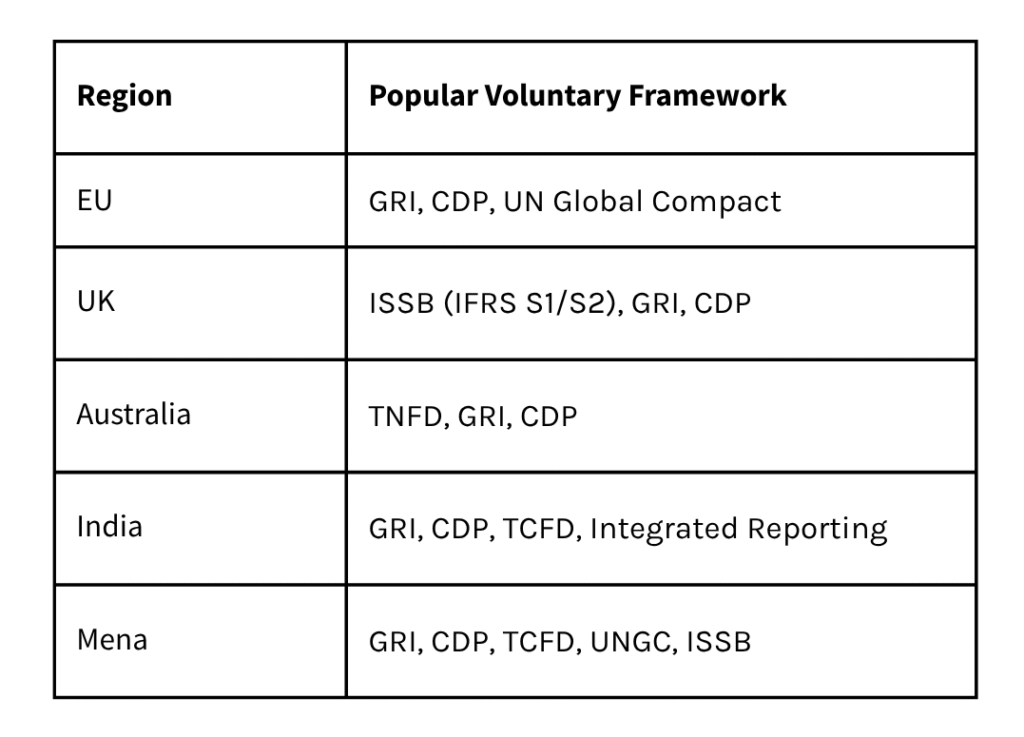
Voluntary Frameworks by Region (Quick Recap)